
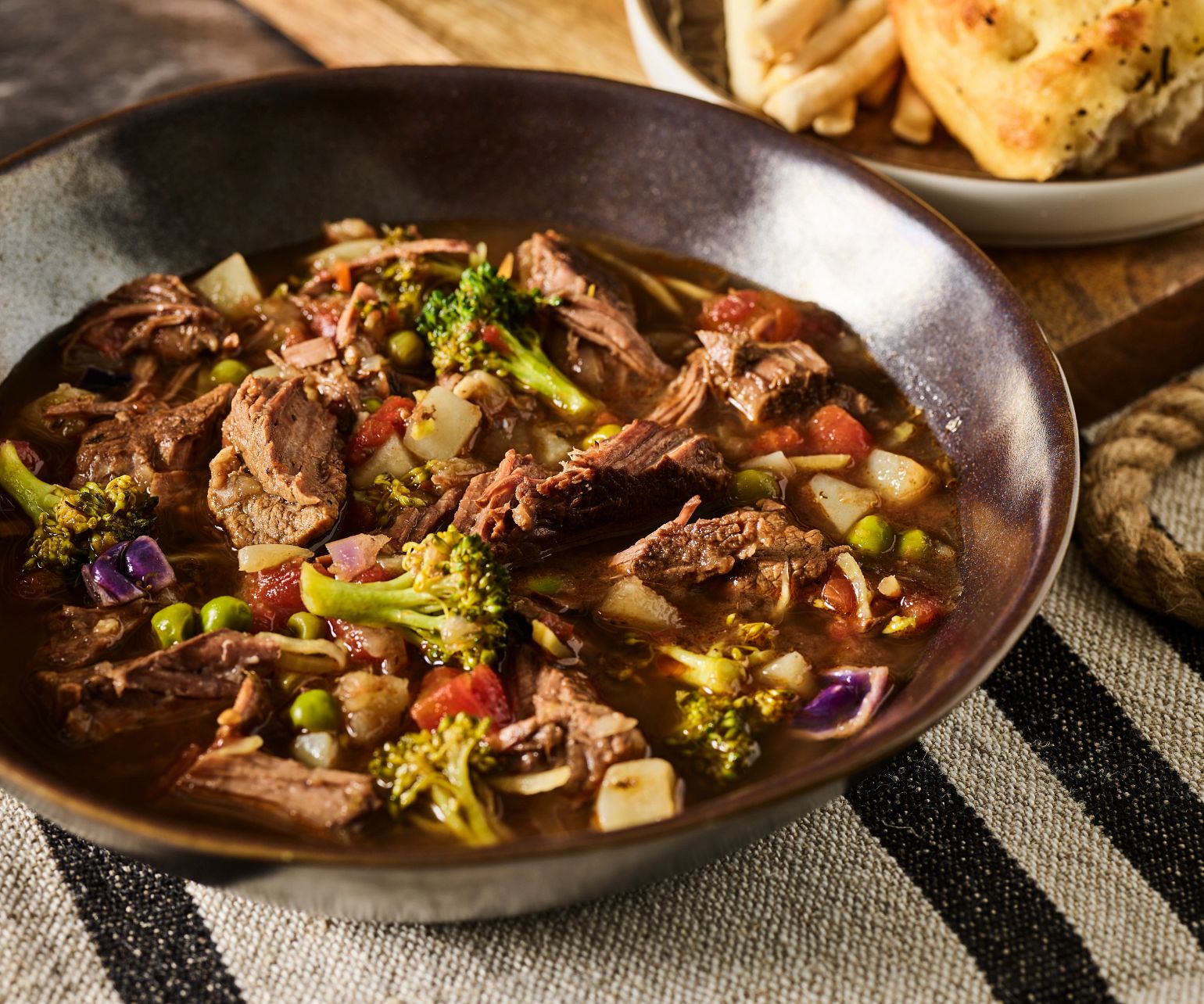
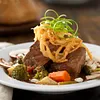
Slow-Cooker Beef Pot Roast Soup
Enjoy all the satisfying flavors of beef pot roast in a soup. Take a short cut with frozen vegetables for an easy to make meal.
Cook Time: 9 hrs
Servings: 6
Ingredients: 11
Ingredients
Preparation
Alternate Cooking Method:
-
Step 1
Cut beef Cross Rib Roast into 12 equal pieces. Place in 4-1/2 to 5-1/2-quart slow cooker. Add onions, tomatoes, potatoes, broth, garlic, thyme, salt and pepper. Cover and cook on HIGH 5 to 6 hours or on LOW 8 to 9 hours or until beef is fork-tender. (No stirring is necessary during cooking.)
-
Step 2
Stir in broccoli slaw; continue cooking, covered, 30 minutes or until broccoli slaw is crisp-tender. Turn off slow cooker. Stir in peas; let stand, covered, 5 minutes.
-
Step 3
This recipe can be made in a 6-quart electric pressure cooker. Cut beef Cross Rib Roast into 1-inch pieces. Place beef roast in pressure cooker; top with onions, tomatoes, broth, garlic, thyme, salt and pepper. Close and lock pressure cooker lid. Use beef, stew or high-pressure setting on pressure cooker; program 15 minutes on pressure cooker timer. Use quick-release feature to release pressure; carefully remove lid. Add broccoli slaw and frozen potatoes. Close and lock pressure cooker lid. Use beef, stew or high-pressure setting on pressure cooker; program 3 minutes on pressure cooker timer. Use quick-release feature to release pressure; carefully remove lid. Add peas and return pressure cooker lid. Let stand 5 minutes. (This recipe variation was tested in an electric pressure cooker at high altitude. Cooking at an altitude of less than 3000 feet may require slightly less cooking time. Refer to the manufacturer’s instructions.)
Nutrition Information
305 Calories
3g SAT FAT
39g PROTEIN
5.1 mg IRON
11 mg ZINC
* Based on a 2,000 calorie diet
** Percent Daily Values are based on a 2,000-calorie diet
Nutrition information per serving: 305 Calories; 81 Calories from fat; 9g Total Fat (3 g Saturated Fat; 0 g Trans Fat; 0.6 g Polyunsaturated Fat; 3.8 g Monounsaturated Fat;) 111 mg Cholesterol; 539 mg Sodium; 17 g Total Carbohydrate; 3.8 g Dietary Fiber; 6 g Total Sugars; 39 g Protein; 0 g Added Sugars; 61 mg Calcium; 5.1 mg Iron; 684 mg Potassium; 5.7 mcg Vitamin D; 0.4 mg Riboflavin; 5.8 mg NE Niacin; 0.7 mg Vitamin B6; 3.8 mcg Vitamin B12; 296 mg Phosphorus; 11 mg Zinc; 62.9 mcg Selenium; 87.7 mg Choline.
This recipe is an excellent source of Protein, Iron, Vitamin D, Riboflavin, Niacin, Vitamin B6, Vitamin B12, Phosphorus, Zinc, and Selenium; and a good source of Dietary Fiber, Potassium, and Choline.
The Essential Ingredients
- Cross Rib Chuck Roast: A flavorful cut from the shoulder area between the chuck and rib sections. Known for its great marbling. it’s ideal for long and slow cooking methods like braising or oven roasting. If it’s unavailable, chuck arm or chuck shoulder roasts are great substitutes.
- Thyme: An aromatic herb with tiny, greenish leaves that can be used fresh or dried and provides a subtle earthy, lemony flavor to recipes.
- Beef Broth: A savory liquid made from beef, beef bones, vegetables and seasonings. You’ll find many boxed or canned versions at the grocery store, including low sodium options). Use in place of water or other liquids to add a depth of flavor.
- Frozen Peas: Sweet green peas that have been harvested at peak time and then flash frozen to preserve nutrients, flavor, and texture. A convenient way to add veggies to soups, stews, stir-fries, salads or side dishes.
- Broccoli Slaw: This crunchy colorful salad mix is made with shredded broccoli stems, carrots and red cabbage. It adds a freshness and texture to salads, sandwiches, and more. It’s a great modern twist on a classic slaw.
Safe Handling Tips:
- Wash hands with soap and water before cooking and always after touching raw meat.
- Separate raw meat from other foods.
- Wash all cutting boards, utensils, and dishes after touching raw meat.
- Do not reuse marinades used on raw foods.
- Wash all produce prior to use.
- Cook steaks and roasts until temperature reaches 145°F for medium rare, as measured by a meat thermometer, allowing to rest for three minutes.
- Cook Ground Beef to 160°F as measured by a meat thermometer.
- Refrigerate leftovers promptly.
For more information on degree of doneness and other cooking tips.
For more information on safe food handling and beef safety.
 Google