
Classic Corned Beef with Cabbage & Potatoes
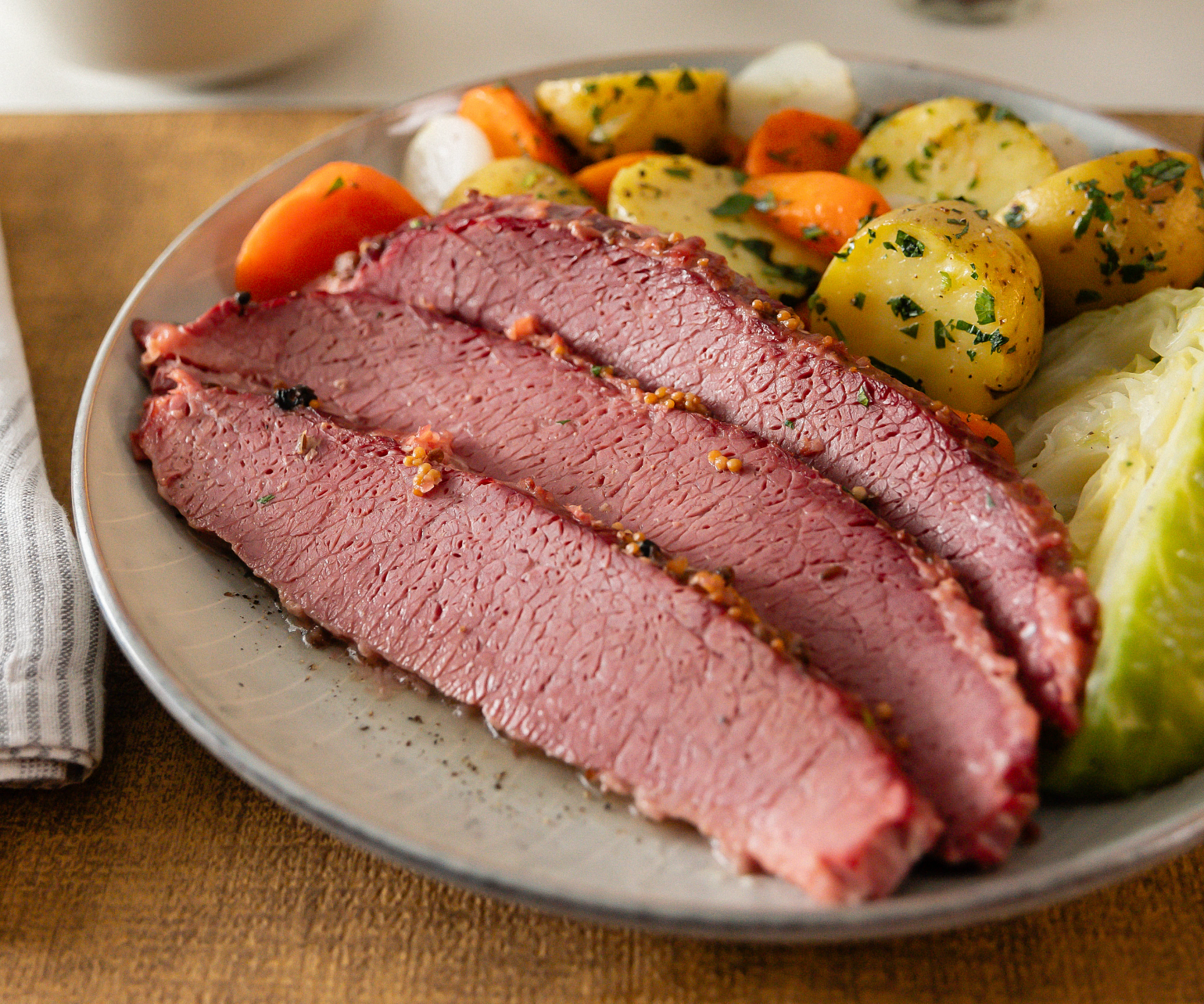
This recipe is a St. Patrick's Day favorite, but you can enjoy any time of the year you'd like. Corned Beef Brisket is slow-cooked with cabbage, potatoes and carrots for a hearty family meal.
Cook Time: 3 hrs 30 mins
Servings: 8
Ingredients: 8
Ingredients
Preparation
Alternate Cooking Method:
-
Step 1
Preheat oven to 350°F. Place Corned Beef Brisket and 3 cups water in large stockpot or Dutch oven, fat-side up. Bring to a simmer. Do not boil. Cover tightly and cook in 350°F oven 2-1/2 to 3 hours or until fork-tender.
Cooking Tip: If seasoning packet is included with Corned Beef Brisket, pour over brisket after the water is added in Step 1.
-
Step 2
Transfer brisket to cutting board, reserving any liquid in stockpot; cover brisket with aluminum foil. Let stand 15 to 20 minutes.
-
Step 3
Meanwhile add 2 cups remaining water to same stock pot with reserved liquid. Place steamer basket in stock pot. (Liquid should not touch bottom of basket). Place cabbage, potatoes and carrots in basket. Bring to a boil. Cover tightly; reduce heat and steam vegetables 20 to 25 minutes or until fork-tender.
-
Step 4
Remove fat from brisket, if desired. Carve brisket into thin slices across the grain. Combine butter, salt and pepper in small bowl. Drizzle over vegetables. Serve brisket with vegetables.
-
Step 5
Recipe can be made in a 6-quart electric pressure cooker. Place Corned Beef Brisket and 1/2 cup water in pressure cooker. If seasoning packet is included with corned beef brisket, pour it over the beef brisket after water is added. Close and lock pressure cooker lid. Use beef, stew or high-pressure setting on pressure cooker; program 70 minutes on pressure cooker timer. Use quick-release feature to release pressure; carefully remove lid. Remove beef; keep warm. Add potatoes, carrots and cabbage to pressure cooker. Close and lock pressure cooker lid. Use beef, stew or high-pressure setting on pressure cooker; program 3 minutes on pressure cooker timer. Continue as directed in Step 4. (This recipe variation was tested in an electric pressure cooker at high altitude. Cooking at an altitude of less than 3000 feet may require slightly less cooking time. Refer to the manufacturer's instructions.)
Nutrition Information
371 Calories
9g SAT FAT
23g PROTEIN
3 mg IRON
5.5 mg ZINC
* Based on a 2,000 calorie diet
** Percent Daily Values are based on a 2,000-calorie diet
Nutrition information per serving, 1/8 of recipe: 371 Calories; 221.4 Calories from fat; 24.6g Total Fat (9 g Saturated Fat; 0.1 g Trans Fat; 0.9 g Polyunsaturated Fat; 11.3 g Monounsaturated Fat;) 119 mg Cholesterol; 1298 mg Sodium; 15 g Total Carbohydrate; 4.2 g Dietary Fiber; 5.2 g Total Sugars; 23 g Protein; 0 g Added Sugars; 86 mg Calcium; 3 mg Iron; 451 mg Potassium; 4.5 mcg Vitamin D; 0.3 mg Riboflavin; 4 mg NE Niacin; 0.4 mg Vitamin B6; 1.9 mcg Vitamin B12; 182 mg Phosphorus; 5.5 mg Zinc; 37.6 mcg Selenium; 93.8 mg Choline.
This recipe is an excellent source of Protein, Vitamin D, Riboflavin, Niacin, Vitamin B6, Vitamin B12, Zinc, and Selenium; and a good source of Dietary Fiber, Iron, Phosphorus, and Choline.
The Essential Ingredients
- Corned Beef: Brisket Flat that’s been salt-cured in brine to preserve the meat to add flavor and moisture. It gained popularity in Ireland and is commonly served for St. Patrick’s Day or in a Reuben sandwich or hash.
- Yukon Gold Potatoes: These potatoes are known for their golden skin, tender flesh and creamy texture. It’s are a great kitchen staple known for its versatility and can be boiled, mashed or cut into pieces and added to stews or roasts.
- Green Cabbage: Derived from the French term meaning ‘head,’ this leafy vegetable has tightly packed waxy green leaves and can be eaten raw or cooked by boiling, sauteing, roasting or fermenting.
- Carrots: Root vegetables known for its bright orange color and high vitamin C content. Carrots are naturally sweet and earthy in flavor, with a crisp texture when raw. You can eat these fresh, cooked or juice them with other vegetables.
- Butter: Does it need an introduction? A rich creamy product made by churning heavy cream until the fat separates from the buttermilk. Comes in both salted and unsalted varieties that can be used in a variety of recipes.
Safe Handling Tips:
- Wash hands with soap and water before cooking and always after touching raw meat.
- Separate raw meat from other foods.
- Wash all cutting boards, utensils, and dishes after touching raw meat.
- Do not reuse marinades used on raw foods.
- Wash all produce prior to use.
- Cook steaks and roasts until temperature reaches 145°F for medium rare, as measured by a meat thermometer, allowing to rest for three minutes.
- Cook Ground Beef to 160°F as measured by a meat thermometer.
- Refrigerate leftovers promptly.
For more information on degree of doneness and other cooking tips.
For more information on safe food handling and beef safety.
Frequently Asked Questions
-
What is oven roasting?
Oven roasting is a dry-heat cooking method that uses (you guessed it) an oven with indirect, ambient heat.
-
Can I use a slow cooker instead of an oven?
Yes. Place corned beef, water and seasoning in a 5-quart slow cooker. Cook on low for 8 to10 hours or high for 4 to 5 hours. Add vegetables the last 2 hours to avoid over cooking.
-
Can I use beef broth instead of water?
Yes, substituting part of the water with beef broth adds depth and richness of flavor. We recommend reduced- or no-sodium beef broth, so the dish doesn’t become too salty.
-
How do you know when corned beef is done?
Corned beef should become fork-tender and reach an internal temperature of 190°F on a meat thermometer.

 Google